Some people describe LLMs as “guessing machines.” They say these models merely guess the next token through statistical correlations, like parrots repeating words, or that they are nothing more than statistical hallucinations with nothing special about them.
But Ilya Sutskever argues that human language itself is a compressed representation of reality.
The reason human language can communicate meaning is that we share the same physical and social world. The words, grammar, and narrative structures within language are all forms of efficient encoding formed through long-term evolution and learning.
When we use language to describe “an apple falling from a tree,” those few short words compress a rich body of knowledge about gravity, object motion, causality, and the physical world. If an LLM wants to accurately predict the next word, it must implicitly learn the world mapped behind human language.
When humans understand language, the activity patterns in the brain’s language areas are highly similar to the internal vector representations of LLMs during language understanding — so similar that a simple linear mapping is enough to infer human brain activity from model representations.
A New Revolution
Industrialization and urbanization created jobs in factories. To put it in less human language: the development of productive forces drove changes in the relations of production. After that, companies continued to expand, and the number of knowledge workers clocking in at offices also increased.
For a long time, we almost took it for granted that economic growth would inevitably bring employment growth — whether in manufacturing, services, or the internet industry. But what if, in the future, economic growth and the number of jobs become unrelated?
This is already happening. Capital now prefers to invest in large-scale compute centers and power infrastructure.

(Image: https://openai.com/index/five-new-stargate-sites/)
The Stargate project, expected to receive hundreds of billions of dollars in investment, consists of five data centers jointly built by OpenAI, Oracle, and SoftBank. It is expected to provide 10 gigawatts of computing power by the end of 2025.
In the past, this money might have flowed into the wages of ordinary people. Now, it is becoming tens of thousands of computing chips, storage systems, network switches, liquid cooling systems…
Since the birth of humanity, we have survived by constantly learning, analyzing, and communicating. The steam engines of the Industrial Revolution may have replaced the Luddites, but in the end, everyone could still continue living more or less peacefully. That was because previous steam engines surpassed humans only in physical capability, while automated machines still could not function without people.
But the emergence of artificial intelligence is a challenge to human centrality. The world’s first kind of machine capable of surpassing humans in cognitive ability has already appeared. AlphaGo, developed by DeepMind, defeated the human world champion in Go. For the first time, we realized that something had quietly changed.
We think software engineering is a task that relies heavily on logic: coupling between modules, management of multiple states, and so on. From the early days of Copilot to today’s Claude, Codex, Cursor, and similar products, from code completion to the rise of vibe coding, AI in software engineering can absolutely surpass 99% of practitioners.
The Impact of AI on Employment
When cars replaced horse-drawn carriages in the 19th century, many carriage drivers became taxi drivers. But perhaps we are not those carriage drivers. Perhaps we are the horses being eliminated.
In August 2025, Stanford Digital Economy Lab released a study on the impact of AI on employment. The title was “Canaries in the Coal Mine? Six Facts about the Recent Employment Effects of Artificial Intelligence.”
There have been many previous studies on AI and employment, but this time, the Stanford team’s data source was especially authoritative. The data came from ADP, the largest payroll processing service provider in the United States. This report was not based on a sample survey, but on ADP’s administrative data. People can lie, but data does not.
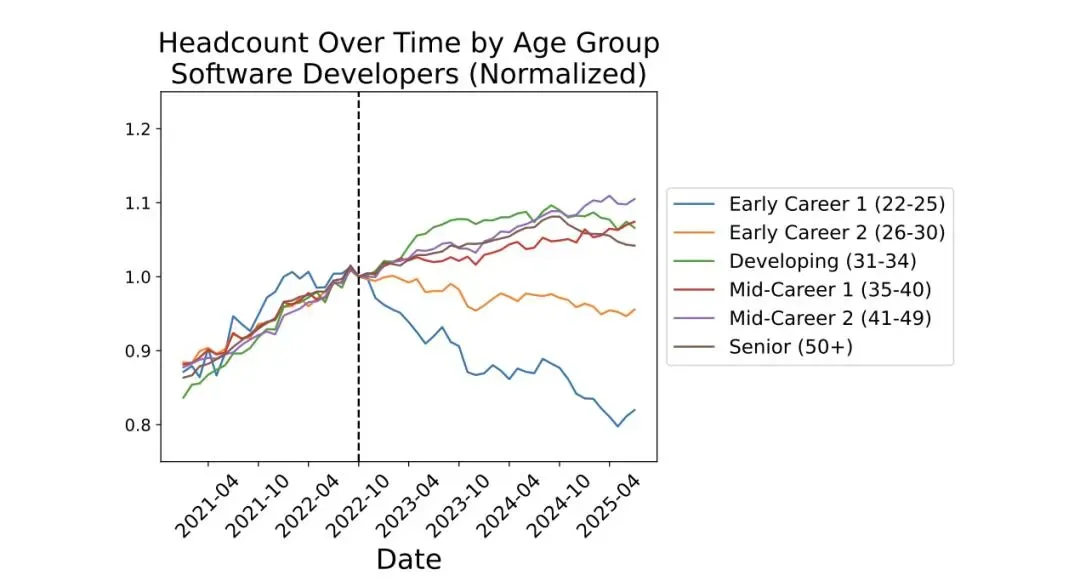
The research report shows that in the 12 months after the release of ChatGPT:
- Decline in entry-level positions: The share of software development jobs requiring less than 4 years of work experience fell by 16.3% in relative terms.
- Reverse age discrimination: In the occupations most affected by AI, employment among young workers aged 22–25 fell by about 13%, while positions for senior employees aged 26 and above remained stable.
Of course, this does not only include the software development industry. In the United States, all industries with high “AI exposure” are facing a decline in entry-level positions. High-exposure industries include software development, administration, secretarial work, paralegal work, accounting and auditing, and market analysis. Education, finance, and middle management fall into the medium-exposure category — which is basically the difference between fifty steps and a hundred steps.
Entry-level positions in most industries are declining. The old path of learning through work practice is narrowing. Companies are becoming less willing to hire young people without work experience.
AI does learn faster than us, work faster than us, and sometimes even work better than us. If this continues, a new useless class may appear in the future. But the truth is harsh; perhaps we should call them the leisure class instead.
Things Are Moving Too Fast…
AI is developing far too quickly. If you compare what GPT-3 Turbo could do in 2023 with what today’s GPT-5.3 Codex can do, you will understand what I mean. In fact, because there is a gap between technological progress and user perception, many non-technical people still have not realized the seriousness of AI.
Many people use free AI tools and then conclude: this thing is still far from replacing me.
But AI today is already different from the old AI that could only answer questions. In December 2025, GPT-5.2 High could already independently complete long tasks that previously required experts 6 hours and 34 minutes. And this number has been doubling every seven months.
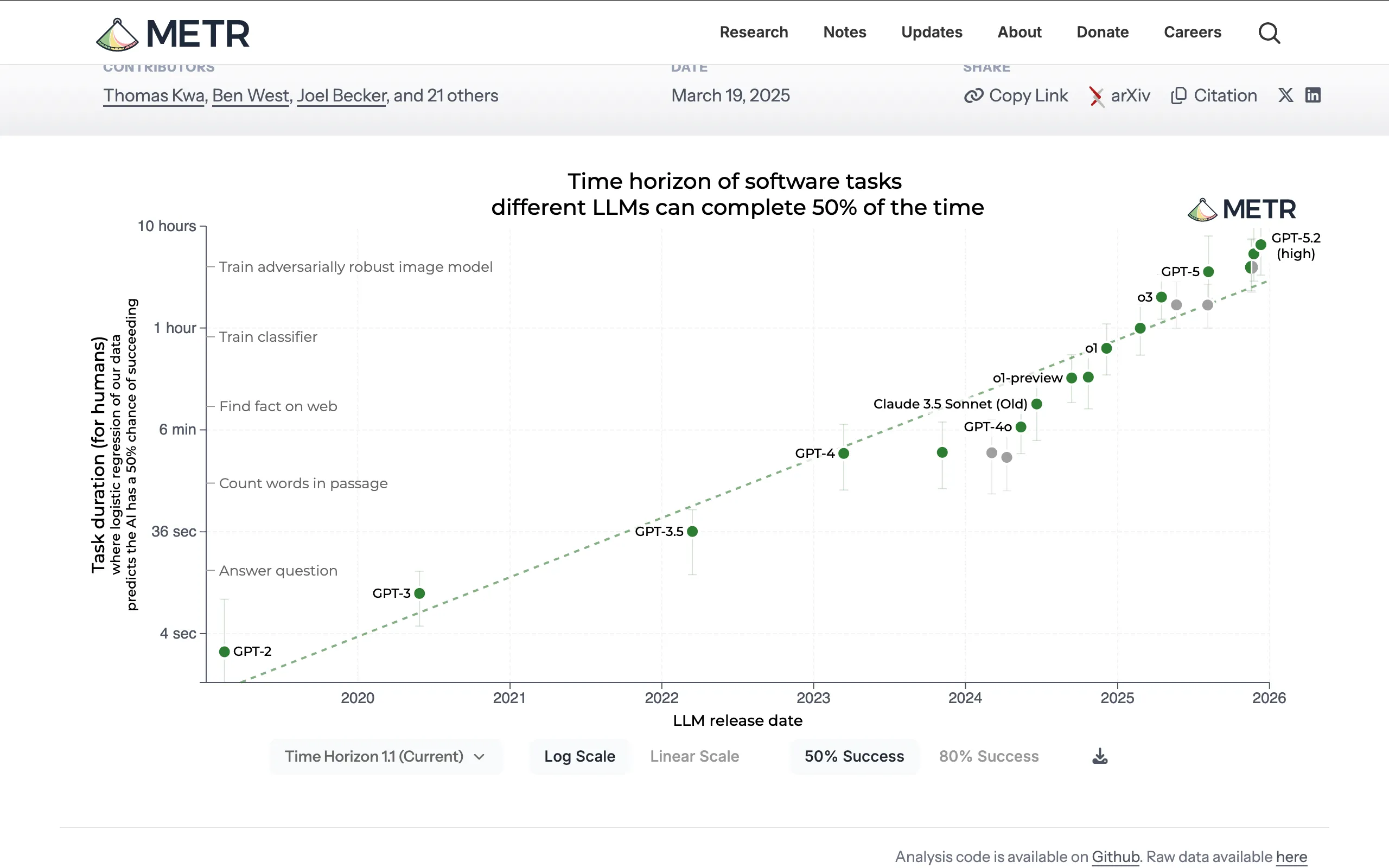
With fierce competition among DeepMind, OpenAI, Anthropic, and other major companies, AI feels completely renewed every six months. In the future, all jobs that require a mouse and keyboard can be disrupted by AI. Our respectable jobs came from informatization, and now informatization has brought us a new technology that will replace our position in the information age.
For now, tasks limited by physical constraints may seem safer, but they will not be able to celebrate for long either. Research in embodied intelligence is also extremely active.
The people who will face the greatest difficulties are those who refuse to participate: those who think artificial intelligence is just a passing trend, those who believe using AI will weaken their professional abilities, and those who are arrogant enough to believe their own field is special and immune. The truth is not so. No field is special.
No industry will be spared.
How People View AI
Coca-Cola’s annual Christmas advertisement “The Holidays Are Coming”
Coca-Cola’s 2024 and 2025 Christmas advertisements were generated entirely by AI. This was undoubtedly a large-scale and highly influential attempt to use AI in marketing. The controversy around the videos was substantial, and there were more opposing voices online than I had expected.
In my view, the overall quality of Coca-Cola’s AI commercial was solid. The only problems were the usual flaws of AI video models: the shots switched very frequently, and the continuity and consistency of the film were weak. Apart from that, I think it was a very important commercial experiment.
It is worth noting that although the 2024 advertisement was also widely criticized, this did not stop Coca-Cola from continuing to use AI advertising in 2025.
From this event, we can see that whether people approve of it or not, the revolutionary change AI is bringing to society is unstoppable.
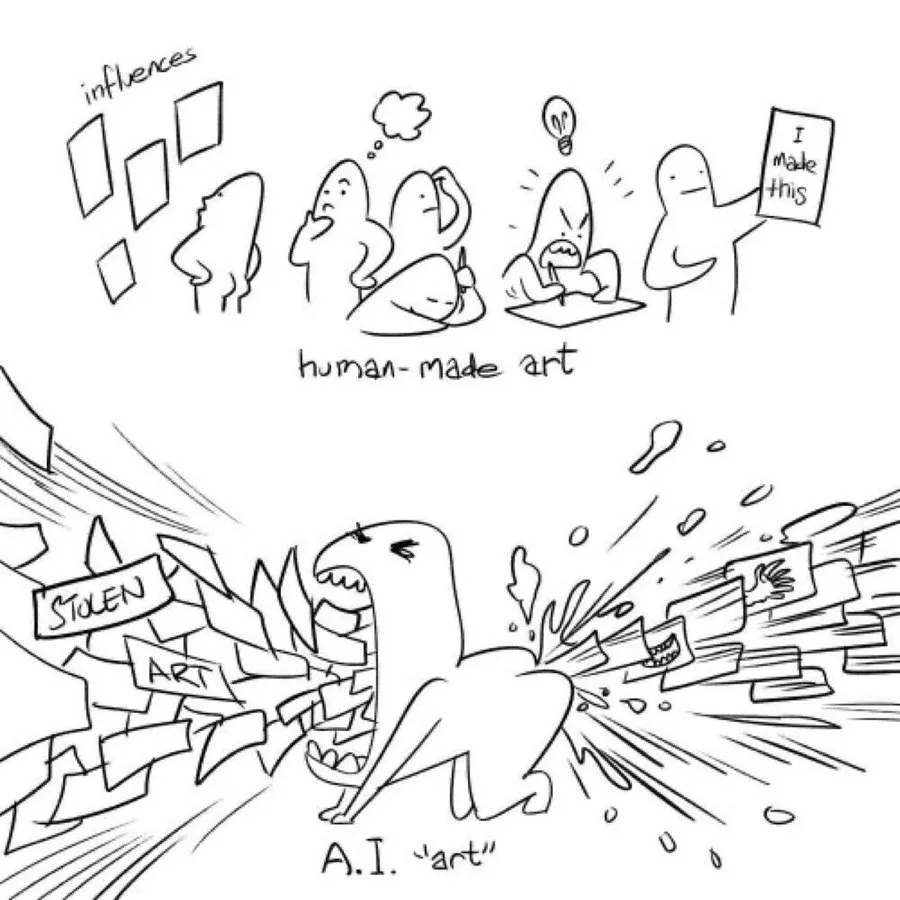
So, is there really nothing we can do under the AI wave?
Let’s listen to the advice of Geoffrey Hinton, the godfather of AI:
— Train to be a plumber! Young people.
My View on AI
Forever support the omniscient and omnipotent AI overlord ✋😭🤚✋😭🤚✋😭🤚
Recommended Reading
AI, Employment, and Social Security — Caijing Magazine
Canaries in the Coal Mine? Six Facts about the Recent Employment Effects of Artificial Intelligence
https://shumer.dev/something-big-is-happening
https://metr.org/blog/2025-03-19-measuring-ai-ability-to-complete-long-tasks